
Fundamental vs Technical vs Quant Investing
Stories, Signals, or Statistics — What Actually Drives Returns?

When I started trading in 2021, I thought investing was about finding great opportunities.
Within a short span, I experienced:
• A liquidity-fueled bull run
• A brutal rate-hike drawdown
• Regime shifts where “great companies” fell hard
• Periods where momentum dominated
• Markets where news, inflation data, and Fed decisions moved everything overnight
That period compressed years of market education into a short time.
And it forced me to confront a hard truth:
The challenge in investing isn’t finding information.
It’s deciding what to trust when uncertainty hits.
That’s where the difference between fundamental, technical, and quant investing really shows.
Fundamental Investing — Understanding the Story
Fundamental investing starts with a simple belief:
Good businesses create good returns.
Investors analyze:
• Earnings and revenue growth
• Profit margins
• Debt levels
• Management quality
• Competitive advantage
But in real markets, fundamentals often expand beyond company data into macro narratives:
• Fed rate decisions
• Inflation (CPI / PPI)
• Government policy changes
• Economic outlook
• Industry cycles
• Even social media sentiment
All of this matters.
But it also introduces complexity.
These variables are:
Hard to quantify consistently
Open to interpretation
Often already reflected in prices before individuals can react
This is where many fundamental investors drift into story investing.
The analysis may be intelligent.
But market outcomes depend on how expectations change — not how logical the story sounds.
I learned this the hard way:
A company can still be “great” while the stock declines for months.
Markets don’t reward business quality alone.
They reward surprises relative to expectations.
Technical Investing — Understanding the Signals
After fundamentals, I moved toward charts.
Technical analysis felt more objective.
Price, trend, momentum — what the market is actually doing.
But real technical trading isn’t just drawing a trendline.
Serious technical traders juggle:
• Multiple timeframes (5 min, 15 min, 65 min, or daily or weekly)
• Moving averages (9, 13, 20, 50, 100, 200)
• ATR for volatility context
• Pivot levels
• Support & resistance zones
• Breakout structures
• Candlestick patterns
• VWAP and anchored VWAP
• Volume profile levels
• RSI / MACD / momentum oscillators
Each tool adds context.
Each tool makes the chart richer and improves visibility.
But here’s what experience revealed:
More tools don’t remove discretion — they often increase it.
Decisions become:
“Price is above the 50 MA but below the 200.”
“Momentum is strong, but volume isn’t confirming.”
“Weekly trend is up, daily looks extended.”
“VWAP is support, but we’re near resistance.”
The analysis becomes sophisticated.
But the decision still ends with:
“What do I think matters most right now?”
That sentence is where discipline breaks. That’s the same psychological trap — just with better vocabulary.
Technical tools improve chart clarity.
They don’t fully remove human judgment.
Quant Investing — Understanding the Probabilities
Quant investing was different.
It didn’t ask what I believed about a company.
It didn’t ask how a chart looked.
It asked:
“Does this rule have a statistical edge across history?”
Real systematic investing isn’t one indicator.
It’s a decision architecture.
Behind the scenes, quant strategies include layers like:
Stock Selection Logic
Objective ranking models based on measurable factors like:
• Momentum persistence
• Relative strength
• Trend confirmation
• Risk-adjusted performance
No opinions. Just rankings.
Market Regime Filters
Markets don’t behave the same in all environments.
Systems often include:
• Broad market trend filters
• Volatility regime checks
• Risk-on vs risk-off conditions
Humans debate during regime shifts.
Systems switch rules.
Risk Controls
Not “I’ll be careful.”
But mechanical structures like:
• Position sizing rules
• Exposure limits
• Volatility-based allocation
• Rebalancing discipline
Risk becomes structural, not emotional.
Rebalancing Logic
Systems define:
• When to rotate positions
• When to remove weakening assets
• How to reallocate capital
This counters the most common human pattern:
Holding losers out of hope.
Selling winners out of fear.
The Real Difference I Discovered
The difference between these approaches isn’t intelligence.
It’s decision pressure.
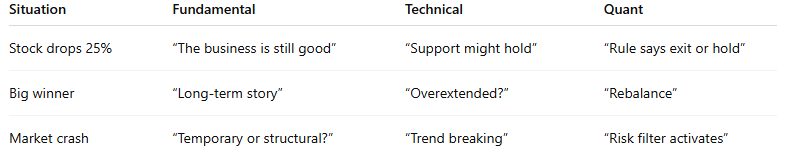
Quant doesn’t eliminate discomfort.
It eliminates decision-making under stress.
That’s enormous.
What Markets Actually Reward
Markets DON’T reward:
Effort
Deep research
Strong conviction
Having a compelling story
They REWARD:
Exposure to persistent trends
Alignment with crowd flows
Participation in repeatable factors
Risk-adjusted positioning
These are behavioral and statistical effects, not narrative ones.
Where I Landed
Fundamentals taught me how businesses work.
Technicals taught me how markets behave.
Quant taught me how to survive myself.
That’s why my decision engine today is rules-based.
Not because it’s perfect.
But because during drawdowns — when emotions spike —
I don’t want to negotiate with fear.
I want to follow a process designed in calm conditions.
Final Perspective
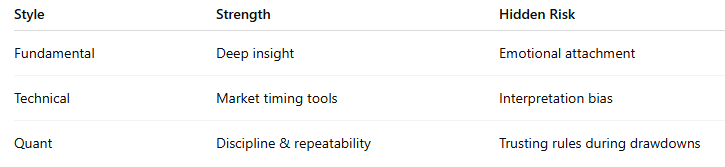
Over time, markets punish:
Stories without risk control
Signals without consistency
They reward:
Structured exposure to statistical edges.
Fundamentals explain businesses.
Technicals explain behavior.
Quant explains performance.
And in investing, performance is the only scoreboard that counts.